VPS deals reader question
How to verify a checkout tax line against the provider's stated billing term
Answer: match the checkout tax line to the same currency, billing term, and pre-tax subtotal shown by the provider. A tax notice on a public VPS page proves only that tax may apply; it does not prove the checkout amount. Save the subtotal, tax, total, and term together.
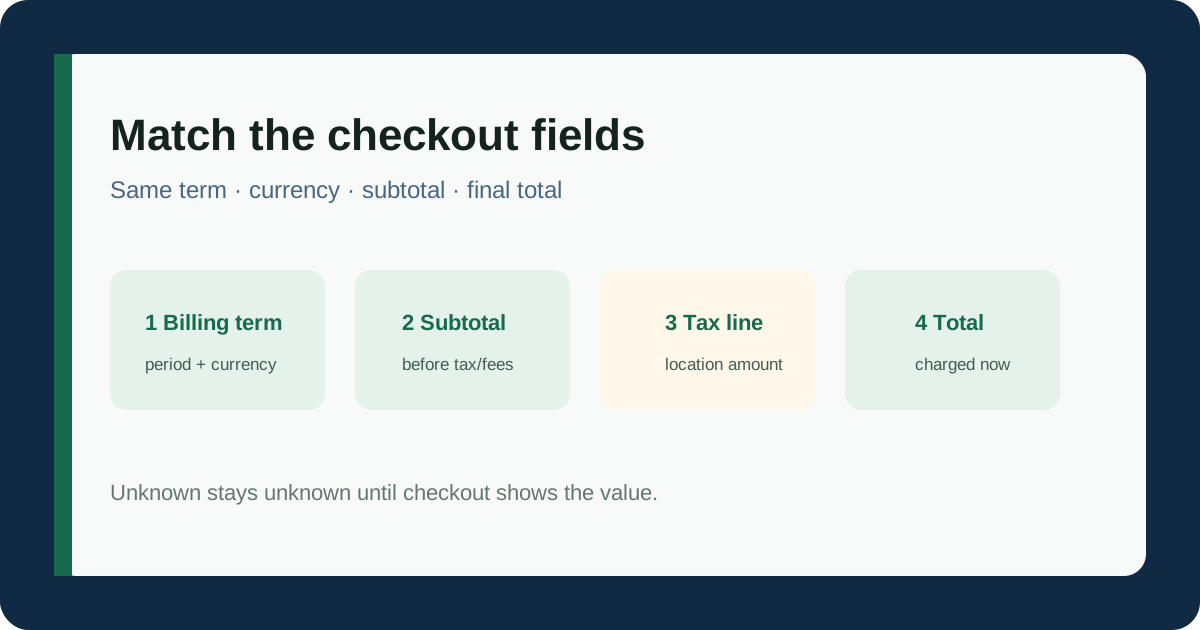
Record the billing term before checkout
Write down the plan name, display rate, currency, promotion duration, and payment term from the public provider page. Hostinger says its VPS plans are paid upfront and that its monthly rate is the total plan price divided by the plan months. That wording means a monthly display rate can describe a prepaid term.
Match four checkout fields
- Term: the period covered by the charge, such as one month or one year.
- Subtotal: the amount before tax and fees in the same currency.
- Tax: the exact line item and rate or amount shown for the checkout location.
- Total: the amount charged now, including the same term and currency.
If the checkout tax line is present but the term changes, stop and reconcile the term first. If the provider says state and local sales taxes may apply, as IONOS does on its public VPS page, keep the customer-specific amount unknown until checkout exposes it.
What this evidence supports
Hostinger's public VPS page was checked at 2026-10-26T04:03:38Z and states that plans are paid upfront. IONOS's public cheap VPS page was checked at the same time and states that state and local sales taxes may apply. Neither source publishes one universal tax amount for every buyer. The checkout's location-specific tax and final total remain factual fields to capture, not values to estimate.
Verification rule: accept the tax line only when it belongs to the same plan, term, currency, and subtotal. Missing or conflicting fields stay unknown.
Continue with the tax-at-checkout comparison guide and the taxes, fees, and final amount guide.
Last public-source check: 2026-10-26T04:03:38Z. Confirm the provider checkout before paying.